The city of Niagara Falls sits at the edge of one of the most dramatic natural spectacles in the world, and most of the tourist infrastructure around it is exactly what you'd expect from a place that receives 14 million visitors a year — a strip of wax museums, haunted houses, and chain restaurants on Clifton Hill that has its own nostalgic charm, alongside a waterfront that has been significantly upgraded in the past decade. The Falls themselves require no embellishment: Horseshoe Falls carries more water over its edge than any other waterfall in the world, and the scale and sound of 2,800 cubic metres of water per second plunging 57 metres is an experience that photographs reliably fail to prepare you for.
The city's appeal extends beyond the Falls into the surrounding wine region — the Niagara Peninsula is Canada's most productive wine appellation, with a particular strength in ice wine — and the historic town of Niagara-on-the-Lake, 15 kilometres north on the river, which is one of the best-preserved early 19th-century townscapes in North America.
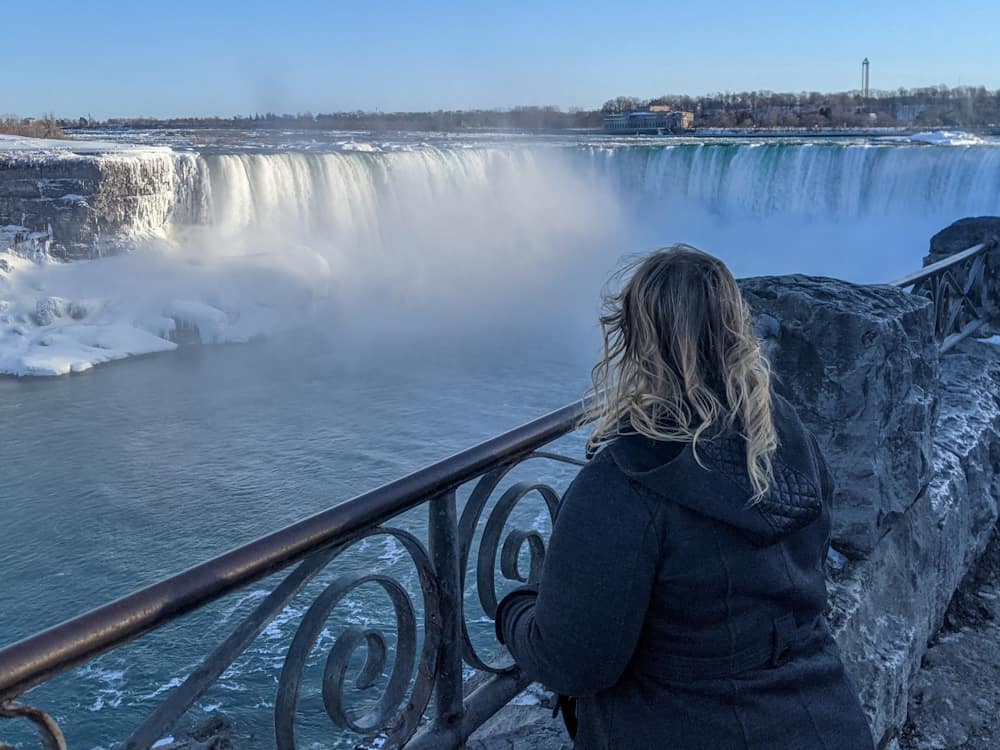
Horseshoe Falls
Horseshoe Falls is the Canadian section of Niagara Falls, an 11-storey drop in a 670-metre arc that handles about 90% of the total water flow shared with the smaller American Falls. The Table Rock Welcome Centre at the edge of the Canadian horseshoe is the main viewing point — the paved terrace puts you within metres of the brink, close enough to feel the spray and hear the constant low roar that is audible from blocks away. The view from here is as close to standing inside a waterfall as most visitors will get.
The mist generated by the Falls is constant and substantial in summer — waterproof layers are more useful than a raincoat. The Falls are illuminated nightly in changing colours after dark and accompanied by fireworks on Friday and Sunday evenings in summer. The path along the Niagara Parkway north of Table Rock stays above the falls and gives the long view of the full horseshoe from downstream.
Journey Behind the Falls
Journey Behind the Falls is an attraction accessed from the Table Rock Centre that takes visitors through tunnels cut into the rock face behind the curtain of water and out to viewing portals within the falls itself. The experience of standing behind a waterfall — watching the translucent green curtain of water descend past the portal opening, hearing the concussive roar amplified by the rock — is genuinely different from any surface viewpoint. The ponchos provided at the entrance are necessary; the spray penetrates everything.
The outdoor viewing deck at the base of the falls, accessed by elevator, provides the lowest and most intimate view of the curtain of water. This section is seasonal and closes in winter due to ice. The tunnels themselves are open year-round. Lines can be substantial in peak summer; book online to skip the ticket queue.
Hornblower Niagara Cruises
The Hornblower (now Niagara City Cruises) boat tour operates from the Niagara Parks dock below Table Rock and takes a catamaran out into the river, past the American Falls, and into the basin directly in front of Horseshoe Falls. The boat gets close enough to the base of the falls that the entire horizon becomes a wall of falling water — the scale from water level is significantly more disorienting than from the cliff top. The ponchos distributed before boarding will be soaked through within minutes of entering the mist zone.
The cruise runs from late April through late October and lasts about 20 minutes. Evening cruises coincide with the illumination of the falls for a different visual experience. Book ahead in peak season as the boats fill quickly on summer mornings.
Niagara-on-the-Lake
Niagara-on-the-Lake, 15 kilometres north of the Falls on the Niagara Parkway, is one of the most intact early 19th-century town streetscapes in Canada. Queen Street, the main commercial strip, is lined with Victorian storefronts housing wine shops, chocolatiers, restaurants, and boutique hotels. The town was the first capital of Upper Canada and was burned by American forces during the War of 1812; the current building stock mostly dates from the reconstruction after 1814. Fort George, a reconstructed British fortification at the river mouth, provides the historical anchor.
The Shaw Festival, one of Canada's premier theatre companies, is based in Niagara-on-the-Lake and performs from April through October in four venues in town. The surrounding wine appellation produces some of Canada's best Riesling, Cabernet Franc, and icewine — the winery strip along Niagara Stone Road and East-West Line Road has over 30 operations within cycling distance of town.
Clifton Hill
Clifton Hill is the tourist entertainment strip immediately uphill from the Falls — a dense concentration of wax museums, haunted houses, mini golf, arcades, go-karts, and chain restaurants that is either overwhelming or nostalgic depending on your perspective. It represents a specific era of North American roadside attraction culture and has a genuine camp appeal. The Clifton Hill Fun Pass bundles admissions to several attractions at a discount.
The Niagara SkyWheel at the top of Clifton Hill is a 53-metre observation wheel with enclosed gondolas that gives elevated views of the Falls, the gorge, and both cities in either direction. The ride takes about 12 minutes. It's open year-round and is particularly atmospheric at night during the Falls illumination. The Movieland Wax Museum and Ripley's Believe It or Not! Museum are the longest-operating attractions on the strip.
Niagara Glen Nature Reserve
The Niagara Glen Nature Reserve, 8 kilometres north of the Falls, is one of the most dramatic and undervisited natural areas in southern Ontario. The Niagara Gorge at this point is 35 metres deep with near-vertical rock walls, and a series of trails descend into the gorge and follow the river's edge through a forest of old-growth carolinian trees. Giant boulders tumbled from the cliff face during ancient gorge migration litter the canyon floor. The geology exposed in the gorge walls is the same ancient Silurian limestone found under most of southwestern Ontario, but here it's vertical rather than horizontal.
The trails are rated easy to challenging depending on route; the descent and ascent are the most demanding sections. The river-level trails are closed in spring when the water table rises. The whirlpool visible from the north end of the reserve results from the river changing direction by 90 degrees — the hydraulics create a standing whirlpool that is one of the most powerful in the world.
Getting to Niagara Falls City
Niagara Falls is on the QEW highway, 130 kilometres from Toronto (90 minutes by car). GO Transit operates frequent train service from Toronto Union Station to Niagara Falls GO station (2 hours). Via Rail also serves the Niagara Falls station with connections to Toronto. Niagara Falls is 5 kilometres from the US border at Rainbow Bridge; Niagara Falls, New York, and Buffalo are easily accessible by car.
Share your Niagara Falls City experience
Powered by TravelGuide Comments — share your thoughts on each attraction above.