Ottawa sits on the south bank of the Ottawa River at the point where Ontario meets Quebec, and the French and English character of the capital is visible in almost every aspect of the city. Government buildings, embassies, and national institutions line the main streets, but the city's day-to-day life — the Saturday morning farmers' market at ByWard, the cycling paths along the river, the neighbourhood restaurants on Elgin and Preston — operates at a scale that feels manageable in a way that most national capitals don't. The Gatineau Hills begin just across the river in Quebec, adding a backdrop of forested ridgelines that keep the skyline from feeling purely institutional.
The national museums are the primary draw and most of them are world-class: the Museum of History across the river in Gatineau is arguably the best history museum in the country, the War Museum is sober and excellent, the National Gallery has one of the most important collections of Canadian art anywhere. Budget at least two full days and consider arriving on the first Sunday of the month when admission to many institutions is reduced.
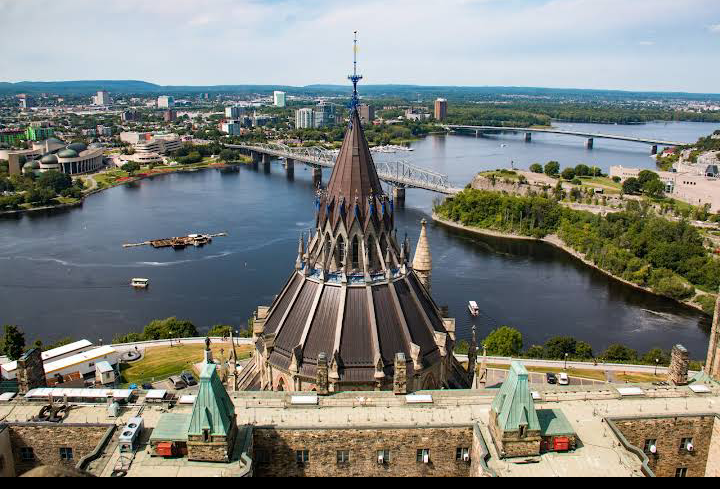
Parliament Hill
The three main buildings of Parliament Hill — the Centre Block with its Peace Tower, the East Block, and the West Block — sit on a promontory above the Ottawa River. The Centre Block is under major renovation expected to continue through 2030, but the grounds, the East Block (restored to its 1870s appearance and open for free daily tours from April to October), and the exterior of the Peace Tower are all accessible. The view from the front lawn looking north across the river to the Gatineau Hills has a particular grandeur that photographs consistently understate.
The Changing of the Guard ceremony runs most mornings from late June through late August on the front lawn, a colourful ritual involving the Governor General's Foot Guards and the Canadian Grenadier Guards in scarlet tunics and bearskin hats. Free, no booking required, runs about 30 minutes. The summer Sound and Light Show projected onto the Centre Block facade runs nightly and is surprisingly polished.
Canadian Museum of History
The Canadian Museum of History sits in Gatineau, Quebec, across the Ottawa River from Parliament Hill, and the building's curved copper facade designed by Douglas Cardinal is one of the most recognizable structures in the National Capital Region. The Grand Hall — a massive glass-walled space containing the world's largest indoor collection of totem poles from the Pacific Northwest Coast nations — is the single best room in any Canadian museum. The poles stand against a wall of windows overlooking the river; the scale of both the poles and the hall itself is difficult to convey.
The Canada Hall on the third floor traces Canadian history from pre-contact to the 20th century through full-scale reconstructions of historic spaces — a Norse encampment, a French colonial square, a 19th-century Main Street. The First Peoples Hall is the most thoughtfully curated section, engaging directly with the complexities of that history rather than presenting it as a simple narrative. Budget at least three hours.
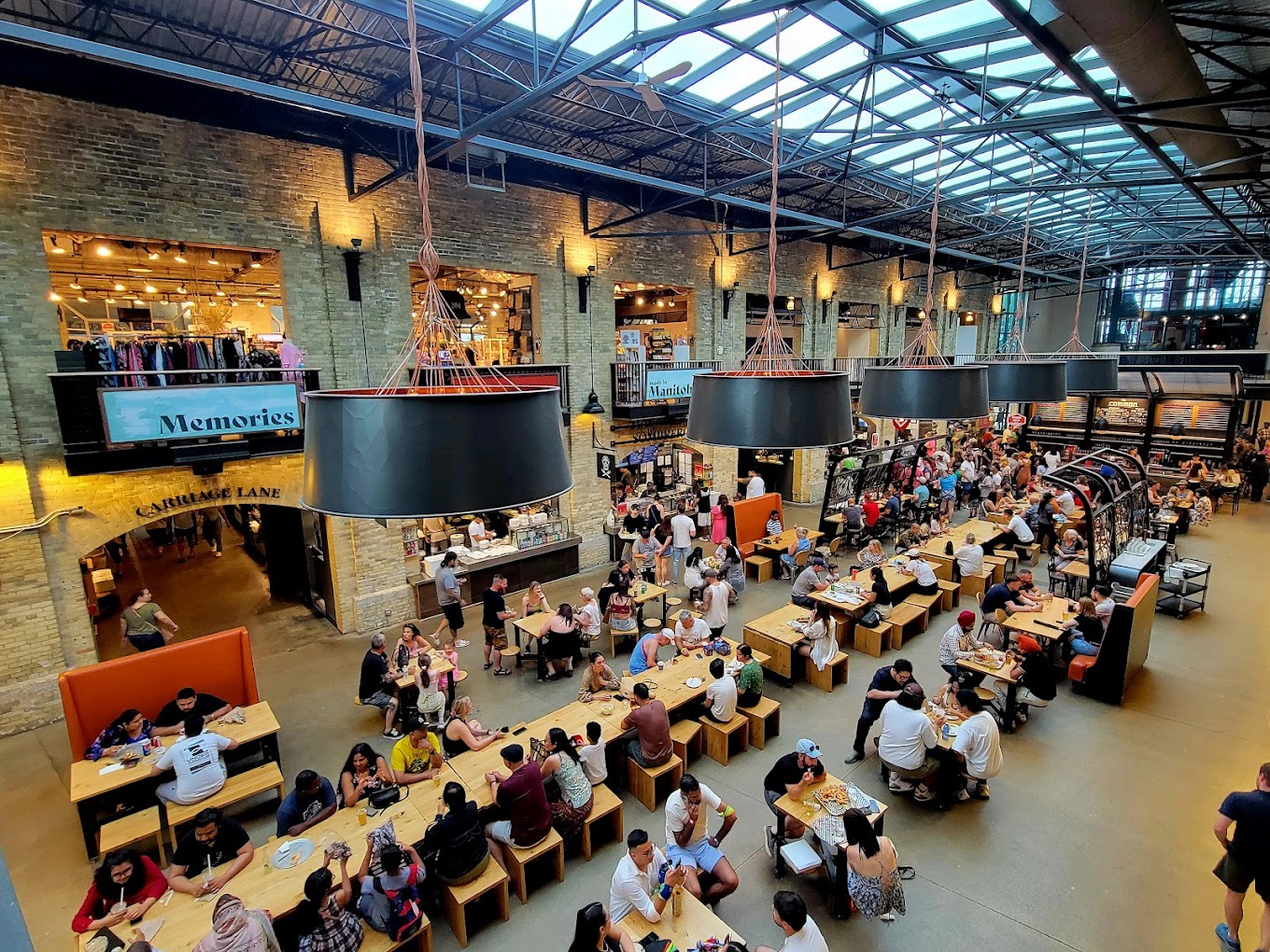
ByWard Market
The ByWard Market neighbourhood, a short walk east of Parliament Hill, has been a commercial centre since 1826 and still anchors Ottawa's food and nightlife scene. The market building itself houses a daily indoor market with local vendors selling produce, cheese, meat, and specialty foods. The surrounding streets — George, York, ByWard itself — have expanded into a dense neighbourhood of restaurants, bars, cafes, and boutiques that run from early morning to late at night.
The BeaverTail stand inside the market is the original location of this Ottawa-born pastry chain — fried dough stretched and shaped to resemble a beaver's tail, traditionally served with cinnamon sugar or toppings. The Byward Market Pub and the Elgin Street Diner (open 24 hours) are Ottawa institutions. The National Gallery of Canada is a ten-minute walk east along Sussex Drive.
National Gallery of Canada
The National Gallery sits on Sussex Drive in a Moshe Safdie-designed building of glass and pink granite overlooking the Ottawa River. The collection includes significant holdings across European, American, and Canadian art, with the Canadian collection being the particular strength. The Group of Seven gallery on the main floor contains the largest holding of Tom Thomson and Group works anywhere — the originals of paintings so widely reproduced that seeing the actual scale and surface can be revelatory.
The Rideau Street Convent Chapel, a 19th-century Gothic Revival interior that was preserved and reinstalled inside the modern gallery when the original convent was demolished, is worth seeking out. The contemporary galleries rotate frequently. The giant spider sculpture outside — Maman by Louise Bourgeois — has become one of Ottawa's most photographed landmarks. The gallery is free on Thursday evenings.
Rideau Canal
The Rideau Canal runs 202 kilometres from Ottawa to Kingston and was built between 1826 and 1832 as a military supply route — now a UNESCO World Heritage Site. The section through Ottawa is a recreational corridor year-round: cycling and running paths along both banks, boat trips in summer, and in winter one of the most famous skating experiences in the world. When the canal freezes and the ice is sufficiently thick (typically January through late February), 7.8 kilometres of maintained ice opens as the world's longest naturally frozen skating rink.
The NCC maintains warming huts along the canal during skating season, and vendors sell BeaverTails and hot chocolate at regular intervals. Skate rentals are available at several locations. The canal runs through Dows Lake, a widened section with a pavilion, and passes through the Glebe neighbourhood on its way south. Even in summer, the canal banks between the Chateau Laurier and Pretoria Bridge make for pleasant walking.
Canadian War Museum
The Canadian War Museum is located in a deliberately dramatic building by Moriyama and Teshima — angular concrete and weathered steel that references the experience of conflict in its forms. The collection spans military history from pre-European contact to modern peacekeeping and combat operations, and the curators have made deliberate choices to present the social and political context alongside the hardware and heroism. The First World War gallery, with its reconstruction of a Vimy Ridge trench and the scale of the casualty figures laid out systematically, is particularly affecting.
The Holocaust Gallery and the post-1945 peacekeeping sections deal honestly with difficult material. The Medal and Insignia Gallery in the basement is surprisingly interesting even for visitors with no particular interest in military history — the objects themselves are beautiful. The Regeneration Hall on the west end of the building has a slot in the roof that allows direct sunlight on November 11 at 11am each year. Plan two to three hours.
Gatineau Park
Gatineau Park covers 361 square kilometres of the Gatineau Hills in Quebec, beginning just across the river from Ottawa. The park is managed by the National Capital Commission and provides the capital with year-round outdoor recreation within 30 minutes of downtown. The Gatineau Parkway runs through the park connecting several lookouts, including the Champlain Lookout at 335 metres above the Ottawa Valley — the best viewpoint in the immediate Capital region. In October, the park's maple and sugar maple forests produce reliable fall colour.
The park has 165 kilometres of walking and hiking trails, including the Skyline Trail (6 km moderate loop near the Champlain Lookout) and the Luskville Falls trail (5 km, steep in sections). Meech Lake and Harrington Lake are within the park boundaries; Philippe Lake has a campground and beach. In winter, the park operates 200 kilometres of cross-country ski trails. The Mackenzie King Estate, the former summer residence of Canada's longest-serving prime minister, contains ornamental gardens and a collection of ruins he collected from bombed European buildings.
Getting to Ottawa
Ottawa is served by Ottawa Macdonald–Cartier International Airport (YOW), about 20 minutes southeast of downtown. The 97 Transitway bus connects the airport to downtown. VIA Rail trains run from Toronto (4 hrs) and Montréal (2 hrs) to Ottawa Station on Tremblay Road, about 3 km from Parliament Hill. Intercity buses including Flixbus and OC Transpo routes serve the main terminal at 265 Catherine Street.
Share your Ottawa experience
Powered by TravelGuide Comments — share your thoughts on each attraction above.