Vancouver sits between mountains and ocean on the southwestern edge of British Columbia, and the physical setting — the Coast Mountains rising directly behind the city, the Pacific to the west, the Fraser River delta to the south — defines the experience of being there as completely as any city in Canada. The downtown peninsula is surrounded on three sides by water, and from virtually anywhere in the city the relationship between the urban fabric and the natural geography is immediate and unambiguous. It's also a genuinely cosmopolitan city of 2.5 million in the metro area, shaped significantly by immigration from Hong Kong, mainland China, India, and the Philippines, and the food culture that results from that demographic complexity is one of the best in the country.
The standard objections to Vancouver — that it's expensive, rainy, and plagued by inequality — are all accurate, but so is the standard enthusiasm: the mountains are right there, the Pacific seafood is outstanding, the cycling infrastructure is extensive, and the quality of public space, from Stanley Park to the seawall, is exceptional by any international comparison.
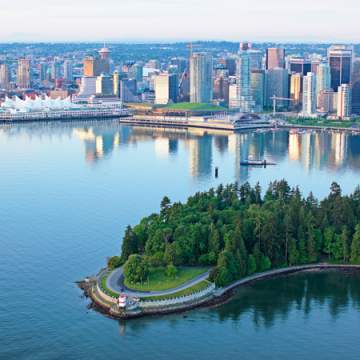
Stanley Park
Stanley Park is a 405-hectare peninsula of old-growth forest, seawall, and public amenity immediately adjacent to the downtown core. The park's seawall runs 8.8 kilometres around its perimeter — flat, wide, and heavily used for cycling, running, and walking, with the city skyline to the south, the North Shore mountains to the north, and the Strait of Georgia to the west. The seawall is one of the most consistently spectacular urban cycling routes in the world, particularly on clear days when the mountain panorama is fully visible.
Inside the park, the forest contains second-growth Douglas fir and western red cedar with a few genuinely old specimens. The Hollow Tree (a large western red cedar stump photographed for over a century) and the totem poles near the Brockton Point lighthouse are the most visited interior points. The Vancouver Aquarium at the park's south entrance is a major facility with beluga whales, sea otters, and Pacific and tropical marine environments. The pitch-and-putt golf course and tennis courts near Beach Avenue are available to the public.
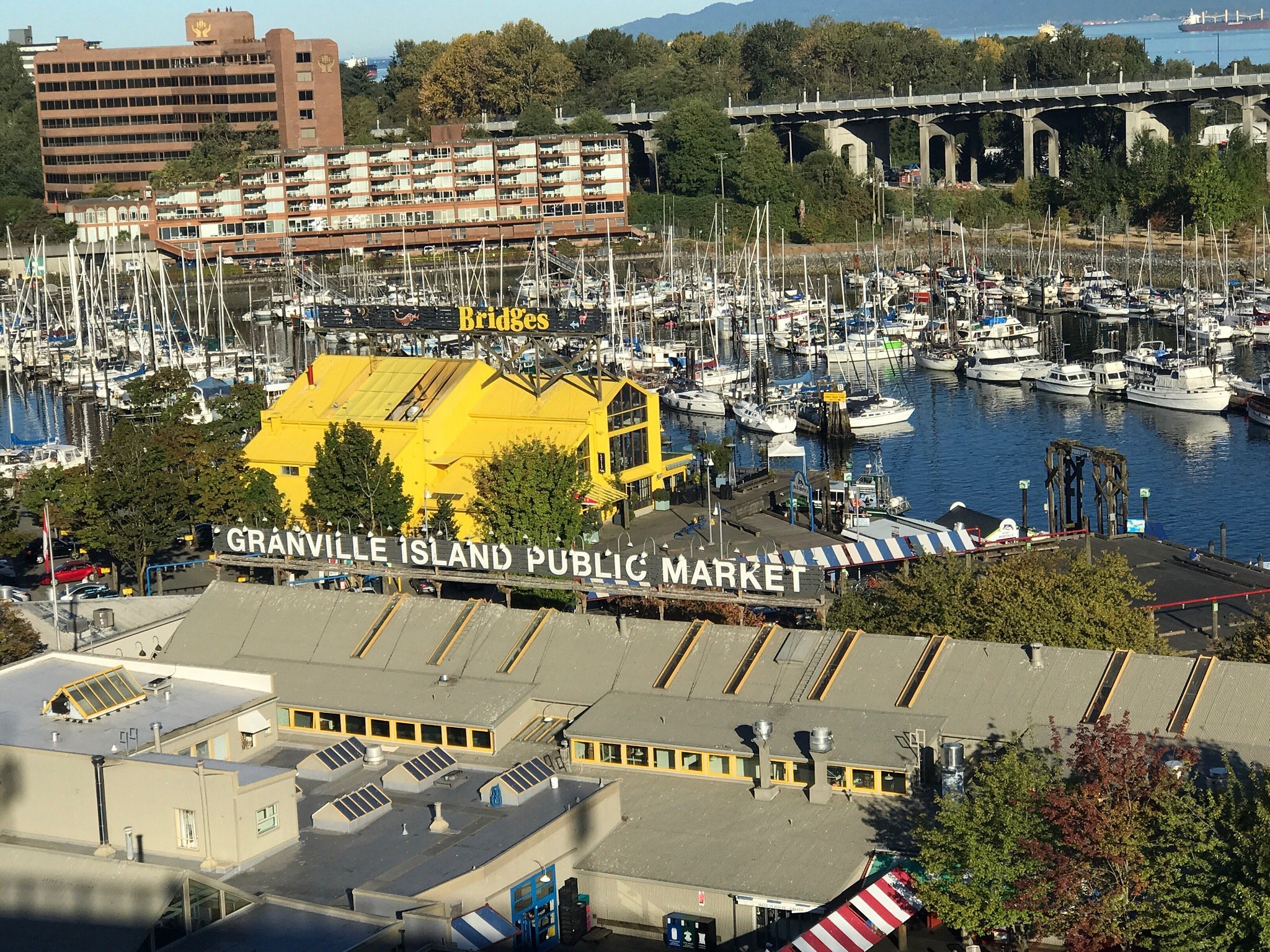
Granville Island
Granville Island is a former industrial peninsula under the Granville Bridge that was converted from heavy industry to arts, food, and public market in the 1970s and has become one of the most successful examples of adaptive reuse in North America. The Granville Island Public Market is the anchor — a covered indoor market operating daily with over 50 food vendors selling fresh seafood, produce, cheese, artisan bread, deli items, and specialty foods. The surrounding area has studios for artisan potters, glass blowers, jewellers, and painters, many of which are open to the public.
The Emily Carr University of Art and Design is on the island, as are several performance theatres including the Arts Club Theatre, a microbrewery, and numerous independent restaurants and galleries. The False Creek ferry (Aquabus) connects the island to the downtown waterfront, the Science World, and the south end of the seawall in a few minutes. The market is busiest on weekend mornings; weekday mornings are more relaxed.
Capilano Suspension Bridge
The Capilano Suspension Bridge in North Vancouver spans 137 metres across the Capilano River gorge, 70 metres above the river. The current steel bridge has been on the site since 1956; the original was built in 1889. Beyond the suspension bridge itself, the Capilano experience has expanded significantly — the Cliffwalk is a narrow cantilevered walkway along the granite cliff face of the gorge, and the Treetops Adventure is a series of seven suspension bridges between old-growth Douglas fir trees 30 metres above the forest floor. The combination provides a genuinely immersive old-growth forest experience with varying degrees of exposure to height.
Admission is expensive (over $60 per adult) and the site draws large numbers of visitors in summer. A less expensive alternative is Lynn Canyon Park, also in North Vancouver, which has a suspension bridge over a deeper gorge and extensive hiking trails, all free. Capilano has a more polished experience; Lynn Canyon is wilder and quieter.
Museum of Anthropology at UBC
The Museum of Anthropology at the University of British Columbia is one of the most architecturally and intellectually significant museums in Canada. Arthur Erickson's 1976 building, with its soaring Great Hall of floor-to-ceiling glass walls, was designed specifically to display totem poles and monumental carvings from the Northwest Coast nations in conditions approximating their original outdoor context — natural light, visible horizon, immediate scale. The Great Hall holds the largest collection of Northwest Coast monumental art in the world.
The Multiversity Galleries — a series of large visible storage cases containing over 10,000 objects — represent a different model of museum presentation, allowing visitors to examine the breadth of the collection without curatorial selection. The Bill Reid Rotunda contains Reid's masterwork Raven and the First Men (1980), a large yellow cedar carving depicting the Haida creation story. The museum is on the UBC campus at the western tip of the Point Grey peninsula.
Gastown
Gastown is the oldest part of Vancouver, named after 'Gassy Jack' Deighton who opened a saloon here in 1867. The neighbourhood was largely rebuilt after a devastating fire in 1886 and the resulting Victorian commercial streetscape — brick and cast iron facades, cobblestone streets — was preserved and restored in the 1970s when it was designated a national historic site. Water Street, the main street, contains the steam clock (a Victorian-styled installation, actually powered by steam from the district heating system) and the densest concentration of restaurants, bars, and galleries in central Vancouver.
The neighbourhood now functions as a mix of tourism, genuine restaurants (including some of Vancouver's most interesting new openings), and the transition zone between the downtown business core and the Downtown Eastside. Maple Tree Square, where Gassy Jack's statue stands, is the historical origin point of the city. The cobblestone alley west of Water Street has mural art and independent boutiques.
Grouse Mountain
Grouse Mountain is the ski resort directly above North Vancouver, visible from most of the city as the illuminated snow slopes in winter. The gondola from the base runs year-round and provides the most accessible elevated view of the city — from the 1,231-metre summit on a clear day, the view spans from the Gulf Islands west of Vancouver east to the Fraser Valley and south to the Olympic Peninsula in Washington State. The top has a ski area in winter (with runs ranging from beginner to expert), and in summer operates zip lines, a lumberjack show, and a resident grizzly bear refuge with two orphaned bears.
The Grouse Grind is a hiking trail ascending 2.9 kilometres and 853 metres in elevation from the base to the summit — a challenging trail that Vancouver residents use as a fitness benchmark. The average completion time is about 90 minutes going up. The gondola takes you back down (a pass is required for the downhill gondola even if you hiked up). Most hikers do the Grind in summer; the trail is closed in winter.
VanDusen Botanical Garden
VanDusen Botanical Garden covers 22 hectares of the Shaughnessy neighbourhood with over 7,500 plant species from around the world organised by geographic origin and plant family. The garden is less widely known than it deserves to be — the Elizabethan Maze, the Korean Pavilion, the BC native plant garden, and the Rose Garden are all worth extended time. The Festival of Lights in December, when the garden is illuminated with hundreds of thousands of lights, is one of Vancouver's most atmospheric winter events.
The building designed by Jim Cheng as the new visitor centre (completed 2011) is a piece of architecture worth examining on its own terms — a green roof structure that references the local landscape forms. The garden is on Oak Street in the south of the city, accessible by bus from downtown.
Getting to Vancouver
Vancouver International Airport (YVR) is on Sea Island, 15 kilometres south of downtown, connected by the Canada Line SkyTrain (25 minutes to Waterfront Station). BC Ferries connects the Tsawwassen terminal south of Vancouver to Vancouver Island. The West Coast Express commuter rail runs from Mission to Waterfront Station.
Share your Vancouver experience
Powered by TravelGuide Comments — share your thoughts on each attraction above.