Top Attractions
10 Must-See PlacesNewfoundland and Labrador joined Canada in 1949 — the last province to do so — and it has always felt like a place apart. The island of Newfoundland is older than most of the world's mountain ranges, its landscape shaped by 500 million years of geology. It has two UNESCO World Heritage Sites, a time zone 30 minutes off from the rest of Atlantic Canada, and an accent so distinctive that linguists study it as a living record of 17th-century Irish and English dialects. It is also, consistently, the place visitors say surprised them most. Come for the scenery. Stay for the people.
Gros Morne National Park
Gros Morne is a UNESCO World Heritage Site for reasons that geologists and hikers both appreciate: the park contains an exposed section of the Earth's mantle at the Tablelands — a barren, rust-coloured plateau of peridotite rock that pushed up from below the ocean floor 500 million years ago. It looks like the surface of Mars and feels similarly otherworldly. Western Brook Pond is a landlocked fjord, a 16-kilometre body of water hemmed in by sheer 600-metre cliffs accessible only by a 3-kilometre walking trail to the boat tour dock. The boat tour through the gorge is one of the most dramatic two hours you can spend in any national park in Canada. The village of Norris Point and the town of Rocky Harbour are the main bases.
Parks pass guide →
Signal Hill, St. John's
Signal Hill rises above the narrows — the dramatic sea-cliff gap that guards the entrance to St. John's Harbour — and the view from the top is one of the finest urban vistas in Canada. The hill has been strategic since the 17th century; it was here, in 1901, that Guglielmo Marconi received the first transatlantic wireless transmission. The Cabot Tower at the summit was built to mark the 400th anniversary of John Cabot's 1497 landing in Newfoundland. The walking trails that loop around the hillside give unobstructed views down to the harbour and out across the open Atlantic. On a clear day you can see why the first Europeans who came this way believed they'd found the edge of the world.
View itineraries →
L'Anse aux Meadows
L'Anse aux Meadows at the northern tip of Newfoundland's Great Northern Peninsula is the only confirmed Norse settlement in North America, occupied around 1000 AD — five centuries before Columbus. The site was excavated in the 1960s by Norwegian explorer Helge Ingstad and his wife, archaeologist Anne Stine Ingstad, who followed clues from the Viking sagas to this remote bay. Parks Canada has reconstructed several of the sod-walled structures, and costumed interpreters demonstrate the daily life of the Norse settlers. The UNESCO designation reflects the site's significance as physical evidence of the earliest European presence on the continent. The drive up the Great Northern Peninsula to get there — through forests of tuckamore and past Iceberg Alley — is itself worth the journey.
Parks pass guide →
Iceberg Alley
Every spring, icebergs calved from glaciers in Greenland drift south on the Labrador Current past the northeast coast of Newfoundland in what is known as Iceberg Alley. The season typically runs from April to July, with peak viewing in May and early June. Twillingate, on Newfoundland's northeast coast, is the most accessible viewing point — you can see bergs from the road, and boat tours put you within metres of ones the size of office buildings. The sheer scale of them is difficult to comprehend until you're alongside one. The berg visible above the waterline is roughly 10 percent of the total mass; the rest is below you. Some years bring dozens of bergs past the coast; some years bring hundreds.
Best time to visit →
Fogo Island
Fogo Island sits off the northeast coast of Newfoundland, accessible by a 45-minute ferry, and it has become one of the most talked-about travel destinations in the country. The island itself is ancient — its interior bogs and rock barrens feel primordial — but what draws visitors is the combination of the extraordinary Fogo Island Inn (a contemporary architecture landmark perched on stilts above the water) and the community arts residency programme that has brought global attention to a community that was nearly abandoned in the 1960s resettlement era. You don't need to stay at the inn to visit the island. The wooden fishing stages, the light, and the quiet are reason enough to come.
View itineraries →
Cape St. Mary's Ecological Reserve
Cape St. Mary's is the most accessible seabird colony in North America. A short trail from the interpretive centre leads to a viewing area where you stand at eye level — often within a few metres — of thousands of nesting northern gannets, murres, kittiwakes, and razorbills on a dramatic sea stack called Bird Rock. The noise, the smell, and the density of life on the rock is overwhelming in the best possible way. Gannets are spectacular birds: white with golden heads, 1.8-metre wingspans, and a habit of diving from 30 metres into the sea to catch fish. Seeing thousands of them at once, with the Atlantic crashing into the cliffs below, is one of the genuinely extraordinary wildlife experiences in Canada.
View itineraries →
Witless Bay Ecological Reserve
Just 30 kilometres south of St. John's, Witless Bay Ecological Reserve protects four small islands that together host the largest Atlantic puffin colony in North America — approximately 260,000 breeding pairs. Boat tours from the villages of Bay Bulls and Witless Bay run throughout the summer, circling the islands while humpback and minke whales feed in the surrounding waters. June and July are peak season, when the puffins are on the islands and the whale feeding is most active. Puffins are small birds and surprisingly fast in the air, but up close from a boat they are comically expressive and entirely unafraid of human company. It's a remarkably easy wildlife experience for one so rewarding.
View itineraries →
Terra Nova National Park
Terra Nova, on the Bonavista Bay coast of central Newfoundland, is the province's most accessible national park — bisected by the Trans-Canada Highway and an easy drive from Gander or Clarenville. The park protects the southern edge of the boreal forest where it meets a deeply indented fjord coast, and the kayaking through the ocean arms is exceptional. The park has consistently good moose and bear sightings along the forest trails; the tidal flats at Newman Sound attract shorebirds in impressive numbers during migration. The Visitor Centre has an indoor viewing aquarium with local species and a good orientation to the park's ecology. For families with children, it's one of the easiest introductions to Newfoundland's wilderness character.
Parks pass guide →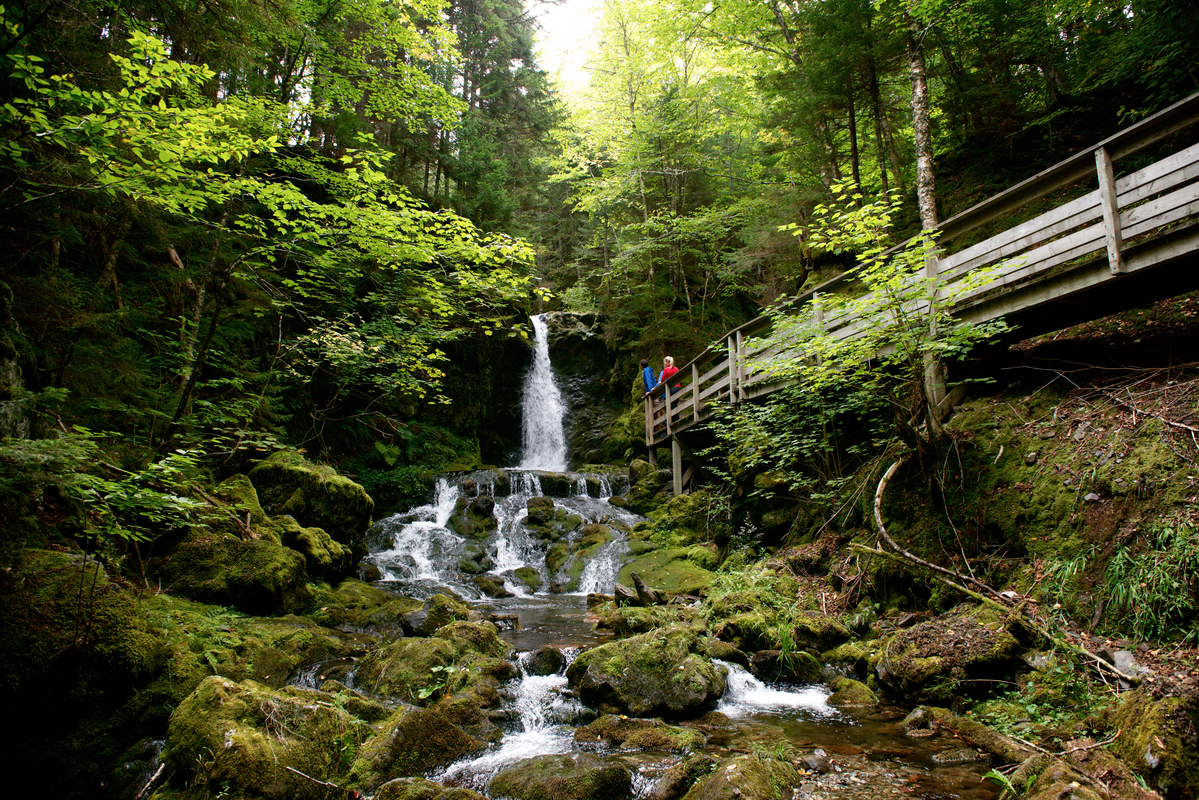
St. John's — Jelly Bean Row & George Street
St. John's is one of the most distinctive cities in Canada. The downtown is built on steep hills above the harbour, its Victorian row houses painted in vivid colours — the Jelly Bean Row houses of Gower Street and the surrounding streets are one of the most photographed streetscapes in Atlantic Canada. George Street, a two-block entertainment district, holds more bars per square metre than any street in North America and is the centre of the city's famous music and pub culture. Newfoundland traditional music — fiddle, accordion, and sea shanty — is genuinely alive here, performed nightly in sessions that any visitor is welcome to join. The craft brewery scene is excellent. The fish and chips at Leo's is not to be missed.
Newfoundland food guide →
Labrador — Red Bay & the Straits
Labrador, the mainland portion of the province, is one of the least-visited and most extraordinary landscapes in North America. Red Bay on the Labrador Straits is a UNESCO World Heritage Site — the remains of the world's largest 16th-century Basque whaling station, where Basque whalers from Spain and France processed thousands of bowhead whales annually. The underwater archaeology preserved in the cold, still harbour is remarkable. The drive along the Labrador Coastal Drive from Blanc-Sablon (accessible by ferry from St. Barbe, NL) passes through small fishing communities that have changed very little in 200 years. For travellers who want to go somewhere that genuinely few people have been, Labrador is that place.
View itineraries →Getting to Newfoundland & Labrador
St. John's International (YYT) has direct connections to Toronto, Montreal, Ottawa, Halifax, and select US cities. Gander (YQX) and Deer Lake (YDF, gateway to Gros Morne) serve domestic routes. Air Canada and WestJet are the main carriers.
Marine Atlantic operates ferries from North Sydney, Nova Scotia to Port aux Basques (6 hours) and Argentia (14 hours, seasonal). The Trans-Canada Highway crosses the island from Port aux Basques to St. John's — 905 kilometres. Renting a car on the island is strongly recommended.
Public transit outside St. John's is minimal. A rental car is essential for visiting Gros Morne, Fogo Island (ferry from Farewell), L'Anse aux Meadows, and the Avalon Peninsula. Road distances are long — allow two hours driving time between major stops.
Newfoundland Standard Time is UTC −3:30 — a 30-minute offset that surprises most visitors when setting alarms. Book Gros Morne boat tours and Marine Atlantic ferries well in advance for summer travel. The "screech-in" ceremony at a St. John's pub is touristy but genuinely fun — kiss the cod and become an honorary Newfoundlander.
Share Your Newfoundland Experience